_edited.png)


Piercing the Silence: Young Feminists are Raising Their Voice Against Femicide in St Lucia

TW: gender based violence, femicide

Earlier this year, we at Caribbean Feminist were following the story of Joy St. Omer, a 24-year-old St. Lucian woman murdered by her ex-husband mere hours after filing a police report against him. This femicide brought to light the failure of the judicial system to protect victims of domestic violence in St. Lucia and had a ripple effect throughout the region and wider diaspora, igniting calls for legislative reform, justice and accountability. This case represents one of an escalating number of femicides in the region.
Femicide is a term that refers to the intentional killing of women and/or girls in which they are targeted exclusively because of their gender or murder that disproportionately impacts women and girls. It is the most extreme manifestation of gender based violence and one that is becoming increasingly prevalent throughout Latin America and the Caribbean.
Recent data from the Gender Equality Observatory for Latin America and the Caribbean, in 2024, shows that at least 3,770 women were victims of femicide, feminicide or gender-related killing in 26 countries and territories of the region (3,756 in 17 countries of Latin America and 14 in 9 countries and territories of the Caribbean).
This represents at least 11 gender-related killings of women each day and a cumulative total of at least 19,237 feminicides recorded in the past five years in the region.
An important dimension to include in this conversation around prevalence is the absence of regional data on femicide. The data from the report accounts only for the statistics provided by the 9 Caribbean countries that reported to ECLAC in 2024. Further emphasising the scarcity of available regional data is the fact that the only Caribbean countries measuring incidences of femicide in 2024 were Suriname, Jamaica, Barbados, Belize, Grenada and Saint Vincent and the Grenadines. What of the others?
Without proper and comprehensive regional data on femicide, we cannot fully understand the scope of this issue. Without a proper understanding of the scope of gendered violence, there is no political will to address the inadequacies within judicial processes that allow perpetrators to roam free and rates of femicide to grow exponentially.
Protesters march holding signs condemning gender-based violence | Photo: Voices Against Violence St. Lucia
In St. Lucia, one of the countries in the region that lacks prevalence data on gender-based violence, it is estimated that the rate of femicide is 4.4 per 100,000 women, according to the International Development Bank (IDB). For a country whose population size sits just under 200,000, this rate is alarming.
As a response, lawmakers have strengthened domestic violence legislation and introduced initiatives like the island’s first Inter-Agency Gender-Based Violence Prevention and Response (GBV) Task Force, which was launched in 2024 to combat the rising rate of GBV. Still, there is a need for a stronger and more comprehensive approach to prevention that goes beyond the purview of the judicial system.
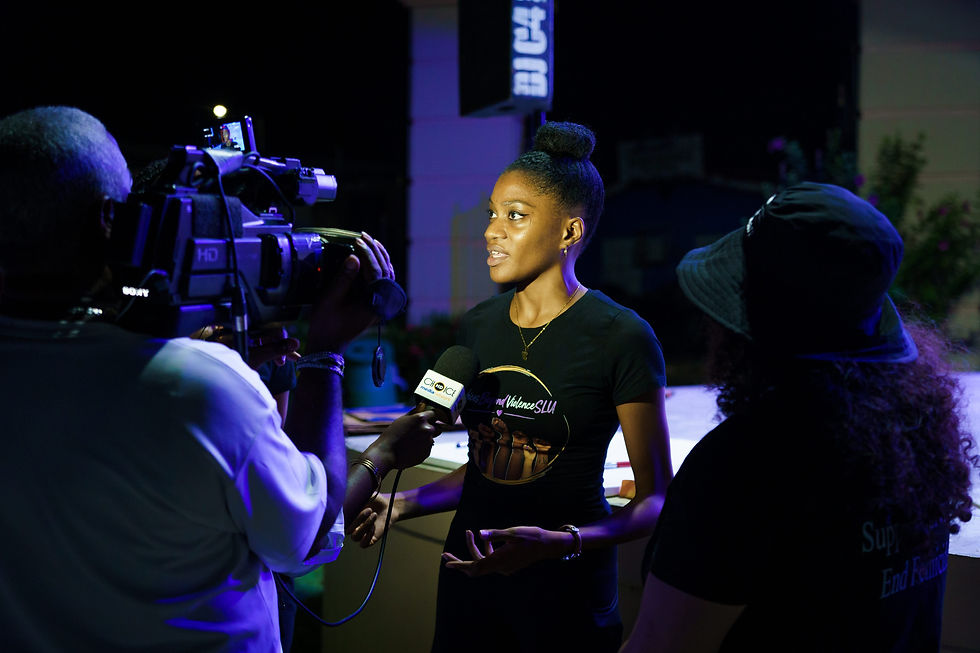
To better understand the dynamics of gender-based violence in St. Lucia, we spoke to the team at Voices Beyond Violence, a youth-led initiative borne from a shared sense of grief and frustration in the aftermath of St. Omer’s murder. Christa St. Ange, Angel Foster and Chrisla Emmanuel are members of this team of young women convening and coordinating this movement for justice.
Sapphire Alexander: Can you share about this project, Voices Beyond Violence, and what brought the three of you to this work?
Angel Foster: Voices Beyond Violence is a movement that was created in response to the murder of Joy St. Omer. Hasana, Christa, and I came together to create this movement and provide a platform where women can speak freely about their experiences. Our mission is to advocate against Gender-Based Violence in Saint Lucia, raise awareness, and push for meaningful legislative reform, including the introduction of a Femicide law.
SA: I want to dive a bit deeper here since you mentioned the introduction of a femicide law. What would a femicide law look like, and why is it important to have this distinction from other offences?
AF: A Femicide law would recognise that some killings of women and girls are not random acts of violence, but are rooted in gender inequality, control, misogyny, and patterns of gender-based violence. While existing homicide laws in St Lucia punish the act of killing, they often do not recognise the gendered nature of these crimes or the warning signs that frequently precede them, such as domestic abuse, stalking, coercive control, sexual violence, threats, and repeated reports to authorities.
A dedicated femicide law could make an impact by creating a legal definition of femicide, allowing the justice system to identify and record these crimes separately from other homicides, improving data collection and reporting, helping policymakers understand the scale of violence against women and develop evidence-based solutions. This law would facilitate institutional change through better training for police, prosecutors, and other agencies on risk factors and victim protection. Lastly, it would send a clear societal message that violence against women is a serious human rights issue that requires targeted prevention measures.
SA: The increase in femicide in St Lucia is following a trend of escalating violence against women that we’re seeing throughout the region, notably in Jamaica and Trinidad and Tobago. What do you see as some of the driving factors behind this rise in violence against women in the region?
AF: In my view, the rise in femicide in Saint Lucia and across countries such as Jamaica and Trinidad and Tobago is driven by a combination of cultural, social, and systemic issues. Too many women are no longer being treated with the dignity, respect, and humanity they deserve. There is a serious lack of education around healthy relationships, consent, emotional regulation, and respect for women from an early age.
When boys and men are not taught these values, harmful attitudes can develop, where control, harassment, and violence become normalised. We also see the influence of social media, misogynistic beliefs, and gender stereotypes contributing to the objectification and devaluation of women.
Another major factor is accountability. When perpetrators see others committing violence against women without meaningful consequences, it sends a dangerous message that these crimes can be committed with impunity. Many women also lose confidence in reporting abuse because they feel the justice system will not protect them or take their cases seriously.
There are also ongoing concerns from victims and advocates about how some domestic violence cases are handled. For example, some victims report feeling judged or dismissed if they return to an abusive partner, despite the fact that leaving an abusive relationship is often a complex and dangerous process. If victims believe they will not be believed or supported because of previous decisions, they may become less likely to seek help, which can leave them at even greater risk. Every report of abuse should be treated seriously, regardless of whether a victim has left and returned to their abuser.
SA: One of the key moments that this movement, Voices Beyond Violence, is known for is convening the island’s first end femicide march. Can you share with us why it was so important for you to host this convening?
Christa St. Ange: The end femicide march back in June was the latest in [a series of] gatherings coordinated by Voices Beyond Violence. Preceding that was a candlelight vigil at the spot in Marigot where Joy was murdered as well as the first meetup, an impromptu candle light gathering, the night after Joy was murdered.
We increasingly realized that gatherings like these are important as a means of community rallying. It is one thing to stay in our corners and be angered by an injustice. It is another when we make the decision to come together, to be sad together, to be disappointed together, angry together. We realised that we are not alone and that this is [issue is] more prevalent than it ought to be. Without that first impromptu gathering, there would be no voices beyond violence. We all met that night of the first gathering, emboldened by yet another atrocity that should have never occurred.
SA: What has the act of having people show up in person meant for you?
CSA: Honestly, it’s a statement. It is time for us to stop ending our activism at likes, comments, reposts, and adding to our story. It is time to start showing up because when we show up, we make it irrevocably clear that violence against women is something that we do not tolerate on our island. People start listening, the police force starts listening, the public service starts listening, the courts start listening, and our systems stand the chance of honestly changing. [When we show up], we stop normalising behaviours and actions that should have never been so common in the first place.

SA: Which moments from these convenings did you find to be the most impactful?
CSA: A moment that really stuck with me at the end of the femicide march was with one attendee in particular. As we gathered at our start point, I remember a woman who happened to be sitting on a nearby bench asking us what was going on. We explained to her the purpose of the march, and almost immediately, with determined certainty, she let us know that she would be joining us because the same thing had happened to her daughter.
Bewildered, we enquired further only to find out she was the mother of Kimberly de Leon, a woman who lost her life back in 2018 under much similar circumstances. Kimberly’s mother made all her necessary arrangements at that moment and spent her evening marching with us; an attendee who knew nothing about the movement or the night’s proceedings marched with us.
Another moment was at the Marigot vigil. To see a space darkened by loss from a tragedy that should have never occurred become a place where love can sit and where we could grieve Joy’s absence in the open. Seeing her family, friends and the public come together, remembering her, as difficult as that was, really stuck.

SA: How can regional feminists support your calls for an end to femicide?
Chrisla Emmanuel: There are many ways that regional feminists can support our call to end femicide. The first one is joint legislative advocacy. There is strength and power in numbers. When smaller nations look to examples of existing legally binding treaties like the Belém do Pará Convention, we find a launch pad for the progressive initiatives that these issues require. Agreements such as this one create a baseline legal framework [that has been designed ] by experts within the justice system, which countries within the treaty can insert into their domestic legal frameworks. Saint Lucia’s own groundbreaking Domestic Violence Act, passed in 2022, expanded the scope of GBV protection, and CARICOM’s Regional Agreement on Legislative and Policy Priorities on Domestic Violence solidified concrete next steps. Both of the aforementioned align with Belém do Pará and other international standards on VAW.
However, this has not directly led to a drop in GBV and Femicide in Saint Lucia, and this is because it does not end with passing a law. An extreme lack of resources (manpower, social safety nets, etc.) and a cultural normalisation of GBV are just a few of the obstacles to these legislative changes. We need the help of regional feminists to not only come together and continue to identify the issues that are plaguing women in their societies and the changes needed to solve them, but also to figure out how best to execute the changes that have already occurred. Other ways that regional feminists can support are through amplifying local voices [in regional spaces], collective sensitisation programmes, capacity building and contributing to existing data ecosystems like the “Caribbean Women Count Data Hub".
To support the work of Voices Beyond Violence, you can connect with their team on Instagram @voicesbeyondviolenceslu
About the Author
Sapphire (she/her) is an intersectional feminist based in Trinidad and Tobago who writes about gender, politics, climate and sexuality.


Comments